Creating a Player-Centered Learning Environment at All Levels of the Game
“Designing Age-Appropriate Sessions to Empower Young Players at Every Stage of Development”


Introduction: Why Player-Centered Matters
Coaching is no longer just about teaching; it’s about facilitating learning. In today’s soccer landscape, the best environments are player-centered, where athletes are not passive recipients of instructions but active participants in their own development. This approach fosters autonomy, creativity, responsibility, and intrinsic motivation, core ingredients for both high performance and lifelong enjoyment of the game.
Whether you’re working with U8s in a grassroots program or U23s in a professional academy, creating a player-centered learning environment requires a clear philosophy, flexible methodology, and intentional leadership.
What is a Player-Centered Learning Environment?
A player-centered environment is one where the needs, experiences, and voices of the players are prioritized. It contrasts with a coach-centered model, where knowledge flows unidirectionally from coach to player.
Key Characteristics:
Players are involved in decision-making and problem-solving
Coaches act as guides and facilitators rather than dictators
Learning is collaborative, inquiry-based, and contextual
Development is holistic, considering technical, tactical, physical, psychological, and social aspects
Feedback is constructive, individualized, and supportive of reflection
Foundations of a Player-Centered Philosophy
At the heart of a player-centered approach is the belief that players learn best when they are engaged, challenged, and trusted. Foundational principles include:
Autonomy Support: Allowing players to make choices fosters ownership.
Relatedness: Building meaningful coach-player and player-player relationships enhances motivation.
Competence: Designing tasks that stretch but don’t overwhelm players builds confidence and mastery.
Individualization: Recognizing that each player learns differently and adjusting accordingly.
Intentional Reflection: Encouraging players to reflect on their performance deepens learning.
These principles align with Self-Determination Theory and Constructivist Learning Models, both of which are well-supported in sport psychology and education literature.
U6–U12: Laying the Foundation
At the grassroots level, creating a player-centered environment revolves around fun, exploration, and discovery. Coaches here play a crucial role in shaping a child’s relationship with the game.
Strategies:
Use guided discovery rather than direct instruction.
Frame training as play-based learning with hidden objectives.
Set up small-sided games where decisions are frequent and player involvement is high.
Praise effort, creativity, and sportsmanship more than outcomes.
Encourage rotating positions and decision-making across different roles.
Coach Tip: Instead of shouting solutions, ask questions like:
“What did you see before you made that pass?”
“Where could you go to find more space?”
Session Example:
A 3v3 “Treasure Hunt” game where players earn points by dribbling through different gates encourages scanning, dribbling, and decision-making in a fun context.
U13–U16: Deepening Understanding & Building Autonomy
At this stage, players begin to understand the game’s complexity and can handle greater cognitive demands. The focus shifts toward tactical awareness, decision-making, and self-assessment.
Strategies:
Incorporate video analysis and peer feedback into sessions.
Use scenario-based games to simulate real match situations.
Promote reflection journals or post-session discussions.
Provide opportunities for players to lead warmups or drills.
Set individual learning goals collaboratively.
Coach Tip: Use frameworks like BOTS (Ball, Opponent, Teammate, Space) to scaffold learning while still letting players discover patterns for themselves.

Session Example:
“Build Out Challenge” – In a 6v6 or 7v7 setup, task one team to build out from the back under different pressing schemes. Ask players to adapt their spacing, communication, and tempo. Pause and replay moments based on player feedback.
U17–U23: Ownership, Accountability, and Performance
With older players, the learning environment must challenge them to take full ownership of their growth while preparing them for competitive and professional demands. Coaches become mentors, analysts, and co-creators of performance plans.
Strategies:
Use individual development plans (IDPs) tailored to player goals.
Create player-led video analysis sessions.
Involve players in tactical planning and match reviews.
Use performance data to promote self-regulation and awareness.
Hold one-on-one coaching conversations regularly.
Coach Tip: Ask players to lead team meetings or conduct presentations on aspects of their game. This deepens understanding and improves communication skills.
Session Example:
“Tactical Lab” – After a match, players watch selected clips and lead the tactical debrief. Coach acts as a moderator, prompting critical thinking and collective solutions.
Coach Behavior: The Silent Curriculum
What you do often matters more than what you say. Your behavior, on the field, during conversations, in your reactions to mistakes, teaches players what kind of environment they’re in.
Coach Behaviors That Support a Player-Centered Environment:
Asking open-ended questions instead of giving answers.
Admitting when you don’t know something and inviting collaboration.
Giving players time to think before answering.
Using calm, constructive tone and body language, even under pressure.
Staying curious: “What can I learn from this player?”
Avoid becoming the “answer key.” Think like a GPS - offering direction, but not taking control of the wheel.
Session Design: Putting Players at the Center
Your session structure reflects your philosophy. Player-centered sessions are:
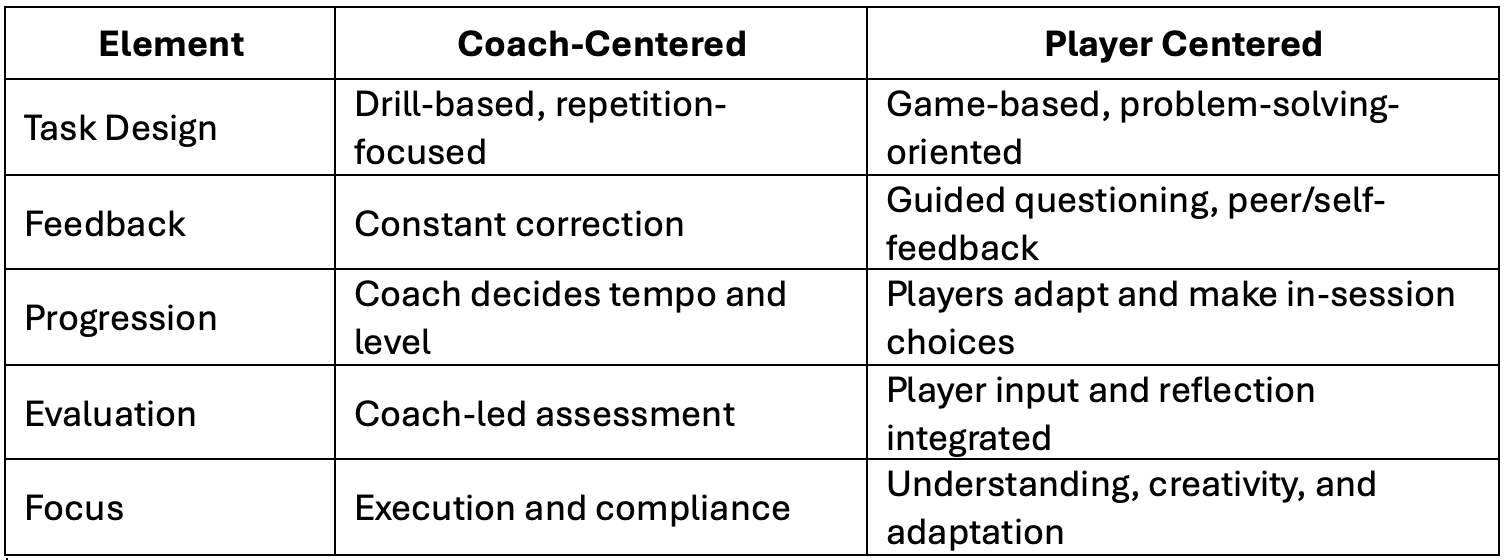
Use constraints-based coaching (e.g., limited touches, altered spaces, time restrictions) to influence behavior without removing autonomy.
Balancing Structure and Freedom
A player-centered approach doesn’t mean chaos. It’s not an excuse to avoid standards or discipline. Instead, it requires clarity of expectations with flexibility in approach.
How to Balance:
Set clear session intentions, but let players find the solutions.
Define roles and values, but allow freedom within the system.
Use rules and boundaries to channel, not stifle, creativity.
A great analogy is the “sandbox.” The coach builds the sandbox (the framework), but the players build castles within it (expression, decisions, learning).

The Role of Communication
Language is a coaching tool. In a player-centered environment, communication should be:
Supportive: Focused on growth, not perfection.
Reflective: Encouraging players to think and respond.
Inclusive: Creating a safe space for all voices to be heard.
Instead of this:
“You must press higher!”
Try this:
“What happens if we press 5 yards higher together? Let’s try and see.”
Use a blend of instructional, motivational, and reflective communication. Be aware of nonverbal cues, tone, eye contact, and posture, especially when dealing with younger or less confident players.
Adapting Across Contexts and Cultures
A player-centered environment must be responsive to cultural values, club philosophy, and player background. What works in one context may need adaptation in another.
Tips for Contextualization:
Learn about your players’ cultural values (e.g., authority, communication norms).
Align with club or federation values while advocating for holistic development.
Engage families and communities in the developmental process.
Example: In a setting where players are used to top-down instruction, gradually introduce choice and questioning rather than making abrupt changes.
Measuring Success Beyond Wins
In a player-centered environment, success isn’t just about results; it’s about development.
Alternative Indicators of Progress:
Improved decision-making under pressure.
Greater engagement and joy in training.
Increased responsibility (on and off the pitch).
Enhanced communication and collaboration.
Self-awareness and self-regulation in performance.
Collect player reflections, session journals, 360-degree feedback, and video-based evaluations as part of your assessment process.
Final Thoughts: Coaching for the Long Term
Creating a player-centered learning environment isn’t a one-off tactic; it’s a philosophical commitment. It means you coach with patience, lead with empathy, and evaluate based on development, not just delivery.
In a world that increasingly values output and results, the most transformational coaches remain focused on what really matters:
“Are my players learning, growing, and falling in love with the game?”
If the answer is yes, you’re coaching the right way.
Key Takeaways
Player-centered coaching develops thinkers, not just doers.
Adapt the environment to the age, stage, and context of your players.
Encourage reflection, decision-making, and accountability at all levels.
Use your behavior and communication as teaching tools.
Evaluate success through learning outcomes, not just game results.
Try This: Weekly Coach Reflection Questions
Did I give players meaningful choices today?
How did I support or hinder player autonomy?
What did I learn from my players this week?
Did my feedback promote thinking or compliance?
How am I growing as a player-centered coach?
Thank you for reading Game Changer. Elevate your coaching with our eBooks full of innovative strategies and practical tips. Click below to explore more and start your journey to smarter coaching!